
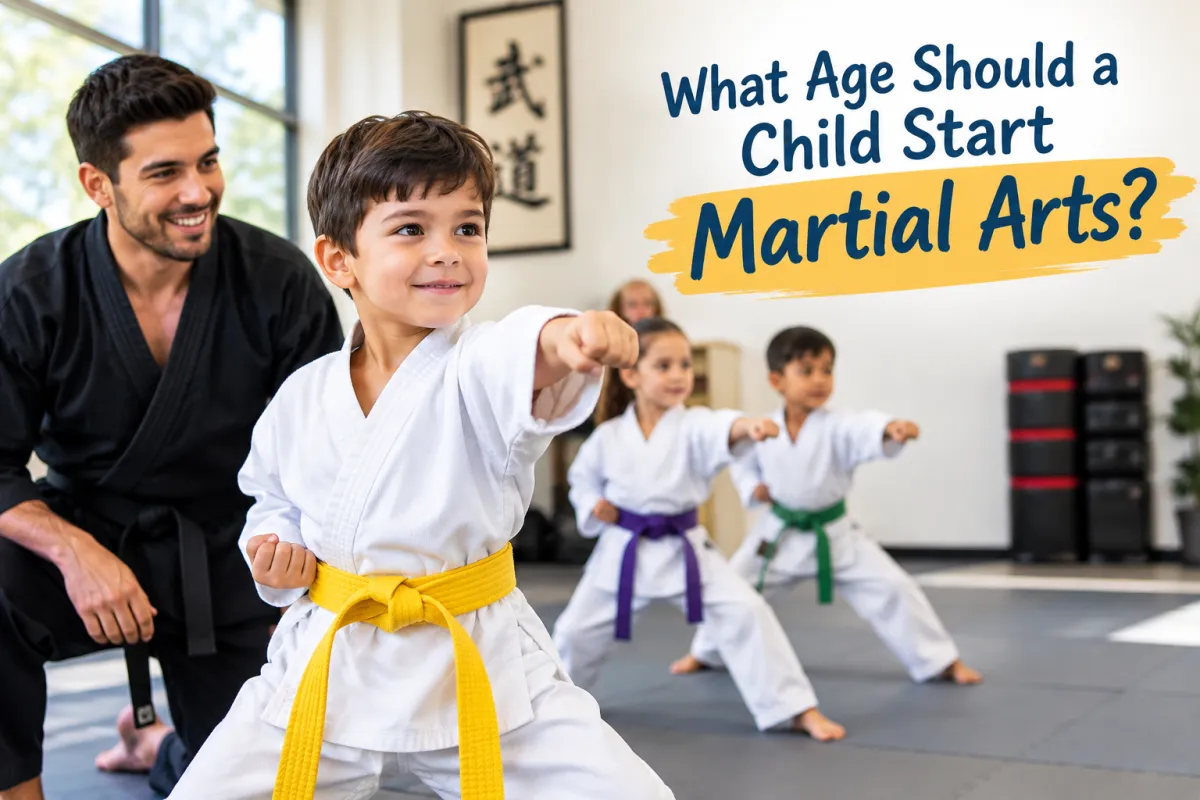
What Age Should a Child Start Martial Arts?
Is There a Perfect Age to Start Martial Arts?
Martial Arts for Preschool-Age Children
Starting Around Elementary School Age
Martial Arts for Older Children
Readiness Matters More Than a Number
What Should a Beginner's First Class Look Like?
Choosing the Right Class for Your Child
Safety Should Always Come First
Martial Arts Can Support Physical Development
Martial Arts Can Teach Discipline and Patience
Confidence Can Develop Over Time
Martial Arts Isn't Just About Fighting
What If My Child Doesn't Like It?
How Parents Can Support Martial Arts Training
What is the best age for a child to start martial arts?
Can a four-year-old learn martial arts?
Is it too late to start martial arts at age 10?
Can teenagers start martial arts with no experience?
What should parents look for in a children's martial arts school?
Parents often wonder when their child is old enough to begin martial arts. There is no single age that works for every child because children develop at different rates. Some are ready for a structured class at a young age, while others may benefit from waiting until they are a little older.
Martial arts can be a fun way for children to stay active while developing coordination, focus, confidence, discipline, and respect. The key is finding a program that matches your child's age, physical development, personality, and ability to follow instructions.
If you're considering martial arts for your child, understanding what different age groups may experience in training can help you make a more informed decision.
Is There a Perfect Age to Start Martial Arts?
There isn't a universal "perfect age" for starting martial arts.
Many schools offer programs for preschoolers, young children, older kids, and teenagers. However, the activities and expectations should be different for each age group.
A young child may spend much of the class learning basic movement, balance, coordination, and listening skills. An older child may be ready for more technical training, structured drills, and advanced challenges.
Instead of focusing only on age, consider whether your child is ready to participate in a group setting and follow simple instructions.
Martial Arts for Preschool-Age Children
Some martial arts schools offer introductory programs for children as young as three or four years old.
At this stage, classes are usually designed around child movement and age-appropriate activities rather than advanced martial arts techniques.
Children may practice:
Balance and coordination
Basic footwork
Simple movements
Following directions
Taking turns
Listening to instructors
Basic physical fitness
Parents should look for programs specifically designed for young children rather than enrolling a preschooler in a class intended for older students.
Starting Around Elementary School Age
Elementary school can be a great time for many children to begin martial arts.
Children at this stage are often better able to understand instructions, remember sequences, participate in group activities, and work toward simple goals.
Training may introduce more structured martial arts skills while continuing to emphasize fundamentals.
Children can begin learning the importance of consistency in life. They may also start working toward belt advancements, depending on the martial arts school.
For many parents, this age can be an opportunity to introduce a regular activity that combines physical exercise with personal development.
Martial Arts for Older Children
Older children can often handle more complex training.
As children develop physically and mentally, instructors can introduce more challenging techniques, combinations, drills, and conditioning exercises.
Training may also place greater emphasis on:
Technique
Coordination
Strength
Flexibility
Self-defense awareness
Goal setting
Discipline
Perseverance
At this age, children may become more aware of their progress and begin setting personal goals within their training.
Teenagers Can Start Too
It's never necessary to assume that martial arts is only for young children.
Teenagers who have never trained before can begin as beginners. A good martial arts school should have an appropriate way for new students to learn the fundamentals without expecting them to already have experience.
Teenagers may be interested in martial arts for several reasons, including fitness, self-defense, confidence, stress management, discipline, or simply trying something different.
Starting later does not prevent a teenager from developing strong martial arts skills.
Readiness Matters More Than a Number
Age is only one part of the decision.
Two children who are the same age can have very different levels of physical coordination, attention, confidence, and maturity.
Before enrolling your child, consider whether they can:
Follow basic instructions
Participate in a group
Take turns
Stay engaged for an appropriate amount of time
Respect instructors and classmates
Handle simple corrections
Understand basic safety rules
If your child isn't ready for a structured class yet, that doesn't mean they won't be ready later.
What Should a Beginner's First Class Look Like?
A child's first martial arts class should be an introduction rather than an overwhelming challenge.
Depending on the child's age and the school's curriculum, a beginner class may include warm-ups, basic movements, simple techniques, games, stretching, and introductory drills.
Instructors should explain activities clearly and provide appropriate guidance.
Children shouldn't be expected to perform advanced techniques during their first class.
A positive first experience can help children feel comfortable and excited about returning.
Choosing the Right Class for Your Child
Finding the right program is just as important as choosing when to start.
Look for a martial arts school that offers classes specifically designed for your child's age and experience level.
Consider the instructor's experience with children, the class size, training environment, safety procedures, and teaching style.
It can also help to visit the school before enrolling. Watching a class can give you an idea of how instructors communicate with students and how children respond to the training.
If trial classes are available, allowing your child to participate can help you determine whether the program feels like a good fit.
Safety Should Always Come First
Parents naturally want to know whether martial arts is safe for their children.
Like many physical activities, martial arts carries some risk of injury. However, instructors can reduce unnecessary risks through proper supervision, age-appropriate training, appropriate equipment, warm-ups, and clear safety rules.
Ask the school how it handles physical contact and whether children are required to use protective equipment for certain activities.
You should also pay attention to whether instructors actively supervise students rather than leaving children to practice without guidance.
Martial Arts Can Support Physical Development
Children need opportunities to move, run, jump, stretch, and develop coordination.
Martial arts can provide a structured form of physical activity that incorporates many different movements.
Depending on the program, children may work on balance, flexibility, coordination, strength, endurance, and body awareness.
The physical activities can also make training enjoyable for children who don't naturally enjoy traditional team sports.
Martial Arts Can Teach Discipline and Patience
Learning martial arts takes time.
Children don't master every movement immediately. They may need to repeat a technique many times before it feels natural.
This process can teach an important lesson: improvement happens through practice.
Children can learn to listen, follow instructions, work toward goals, and continue practicing when something feels difficult.
These habits can be useful outside the martial arts school as well.
Confidence Can Develop Over Time
Starting a new activity can feel intimidating.
A child may be nervous about meeting new students or trying unfamiliar techniques. As they become more comfortable and see themselves improving, they may begin to feel more confident.
Learning a new skill, earning a new belt, or successfully completing a challenging exercise can give children a sense of accomplishment.
However, confidence shouldn't be forced. Children develop at their own pace, and instructors should encourage progress rather than compare students unnecessarily.
Martial Arts Isn't Just About Fighting
One common misconception is that children learn martial arts primarily so they can fight.
Responsible martial arts programs teach much more than physical techniques.
Children can learn about respect, self-control, awareness, discipline, responsibility, and perseverance.
Self-defense may be included in the curriculum, but children should also learn that avoiding unnecessary conflict is important.
The objective is to help children understand how to use their skills responsibly.
What If My Child Is Nervous?
It's completely normal for a child to feel nervous before starting something new.
Instead of forcing them into a class, give them time to become familiar with the environment.
You might visit the school together, watch a class, speak with the instructor, and explain what the first lesson will be like.
A supportive instructor can also help a nervous beginner feel comfortable by introducing activities gradually.
Once children become familiar with the routine, their confidence often grows naturally.
What If My Child Doesn't Like It?
Not every activity will be right for every child.
If your child tries martial arts and decides they don't enjoy it, listen to their concerns. Find out whether the issue is the instructor, class structure, difficulty level, schedule, or simply the activity itself.
Sometimes trying a different class or school can make a difference.
The goal should be to find a healthy activity that your child can enjoy and participate in consistently.
How Parents Can Support Martial Arts Training
Parents can make a big difference in their child's experience.
Encourage your child to attend regularly and celebrate effort rather than focusing only on belts or competition results.
Ask about what they learned and let them talk about their experiences.
Avoid comparing your child's progress with another student's. Every child develops skills at a different pace.
Most importantly, help your child understand that mistakes are a normal part of learning.
Final Thoughts
So, what age should a child start martial arts?
There isn't one answer for every child. Some children may be ready for introductory martial arts activities during the preschool years, while others may be more comfortable beginning during elementary school or even as teenagers.
The most important factors are your child's readiness, interests, developmental level, and the quality of the program.
Choose a school that provides age-appropriate instruction, experienced instructors, clear safety practices, and a positive learning environment.
When children are given the right environment and enough time to develop, martial arts can become much more than a physical activity. It can give them opportunities to build coordination, confidence, discipline, focus, perseverance, and respect while enjoying an activity they can continue developing for years.
Frequently Asked Questions
What is the best age for a child to start martial arts?
There is no universal best age. Many schools offer programs for preschoolers and older children, but the appropriate starting point depends on the child's development, attention span, personality, and ability to follow instructions.
Can a four-year-old learn martial arts?
Some martial arts schools offer classes specifically designed for preschool-aged children. These programs typically focus on movement, coordination, listening, balance, and basic discipline rather than advanced techniques.
Is it too late to start martial arts at age 10?
No. A ten-year-old can begin martial arts as a beginner. A properly structured children's program can introduce techniques gradually while helping the child develop fitness, coordination, discipline, and confidence.
Can teenagers start martial arts with no experience?
Yes. Teenagers can begin martial arts without previous experience. They should look for a program that provides beginner-friendly instruction and appropriate training for their age.
What should parents look for in a children's martial arts school?
Parents should consider the instructors' experience, age-appropriate classes, safety procedures, class environment, schedule, training philosophy, and whether their child feels comfortable and motivated to participate.