
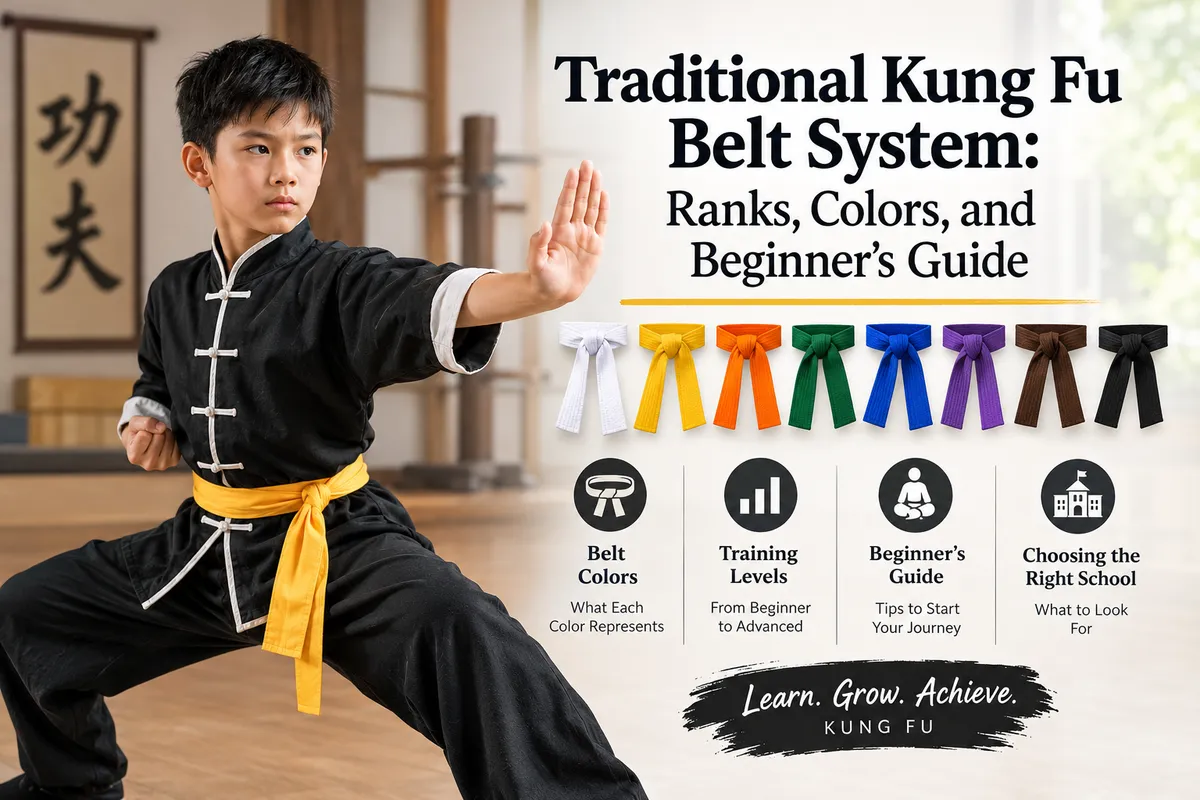
Traditional Kung Fu Belt System: Ranks, Colors, and Beginner’s Guide
Starting a martial art can feel exciting, especially when you are learning about its traditions, techniques, and ranking system. For beginners, one common question is how the Kung Fu belt system works and what each belt color represents.
Unlike some martial arts, Kung Fu does not have one universal belt system. Different schools and styles use different ranking methods. Some award colored sashes or belts, while others focus on forms, skill development, instructor evaluations, and traditional levels of achievement.
Understanding these differences can help you choose the right school and set realistic goals for your training journey.
What Is the Traditional Kung Fu Belt System?
The Kung Fu belt system is a way some martial arts schools recognize a student's progress, knowledge, and technical ability. Depending on the school, students may earn colored belts, sashes, certificates, or other forms of recognition as they advance.
Kung Fu includes many styles, such as Shaolin Kung Fu, Wing Chun, Hung Gar, and Choy Li Fut. Each has its own history, techniques, and training traditions. Because of this diversity, the ranking structure can vary significantly from one academy to another.
Some schools organize students into beginner, intermediate, and advanced levels. Others use a structured sequence of colors to show progress. Traditional schools may place greater emphasis on mastering fundamental movements, forms, discipline, and practical applications rather than earning a particular belt.
If you are researching martial arts for yourself or your child, it is worth asking how a school measures progress before enrolling.
Do All Kung Fu Schools Use Belts?
No, not all Kung Fu schools use belts. This is one of the most important things beginners should understand.
In many Karate and Taekwondo schools, colored belts are a familiar part of the curriculum. Kung Fu schools, however, follow a wider variety of traditions. Some use colored sashes or belts, while others use instructor assessments, training levels, certificates, or other methods to recognize achievement.
Neither approach automatically makes a school better than another. What matters is whether the curriculum is organized, the instructors are qualified, and students have a clear understanding of their learning goals.
When comparing schools, ask whether advancement depends on attendance, technical ability, forms, sparring, self-defense skills, or a combination of these factors.
Common Kung Fu Belt and Sash Colors
There is no official color sequence followed by every Kung Fu school. However, some modern Kung Fu academies use colors to represent different stages of learning.
The following table provides a general example, not a universal ranking system.
Belt or Sash Color | Possible Meaning |
White | Beginning training and learning basic movements |
Yellow | Developing foundational techniques and coordination |
Orange | Improving balance, movement, and basic combinations |
Green | Building consistency and learning more advanced techniques |
Blue | Developing greater control and understanding of applications |
Purple | Refining technique and improving combinations |
Brown | Demonstrating stronger fundamentals and greater experience |
Black | Advanced proficiency within a school's particular ranking system |
Some schools use only a few colors, while others use different colors or additional levels. In traditional Kung Fu, a black belt is not necessarily the final or universal measure of mastery.
Always check the school's own ranking requirements rather than assuming that a color means the same thing everywhere.
Beginner Level: Learning the Fundamentals
Every Kung Fu journey starts with the basics. Beginners usually focus on building a strong foundation before attempting complex techniques.
Early training may include proper stances, basic punches, controlled kicks, defensive movements, footwork, and body coordination. Students also learn how to follow instructions, maintain focus, and practice safely with others.
A beginner might feel awkward during the first few classes. That is completely normal. Balance, flexibility, timing, and coordination improve through regular practice rather than overnight.
If you are looking for a school that can help you learn the fundamentals, you may find it useful to explore martial arts classes at White Tiger World.
Intermediate Level: Building Technique and Confidence
As students gain experience, training often becomes more challenging. They may begin practicing longer combinations, more detailed forms, partner drills, and applications of the techniques they have learned.
At this stage, the goal is not simply to remember movements. Students work on performing them with better balance, timing, accuracy, and control.
Intermediate training also encourages patience. A technique that looks simple may require many repetitions before it feels natural. Students gradually learn to recognize mistakes, accept feedback, and make improvements.
Progress depends on the student's attendance, practice habits, learning pace, and the school's curriculum. There is no single timeline that applies to every student.
Advanced Level: Refining Skill and Understanding
Advanced Kung Fu training typically focuses on refining technique, understanding applications, and demonstrating consistency under more demanding conditions.
Depending on the style and academy, advanced students may study complex forms, traditional training methods, controlled partner exercises, conditioning, or teaching skills.
Reaching an advanced level is not just about performing movements quickly. Good technique requires control, awareness, appropriate distance, and an understanding of when a technique should or should not be used.
Advanced students are also expected to maintain respect for their instructors and training partners. The purpose of training is to develop skill responsibly, not to prove superiority over others.
How Long Does It Take to Progress in Kung Fu?
The time required to advance through a Kung Fu ranking system depends on the school, training frequency, curriculum, and individual progress.
Some schools assess students after a set training period, while others require them to demonstrate specific skills before advancing. More experienced levels generally require greater consistency and a deeper understanding of the material.
A student attending classes several times a week may progress differently from someone attending once a week. However, attendance alone does not guarantee advancement.
Instead of focusing only on the next belt or sash, beginners should set practical goals, such as improving their stance, remembering a form, increasing flexibility, or performing a technique with better control.
These small improvements build the foundation for long-term development.
What Should Beginners Look for in a Kung Fu School?
Choosing the right academy is an important step in learning Kung Fu. A well-organized school should provide a welcoming environment, clear instruction, and training appropriate to each student's experience.
Look for instructors who explain techniques carefully, demonstrate movements clearly, and correct mistakes respectfully. Safety should be a priority during warm-ups, conditioning, partner drills, and any contact-based training.
It is also helpful to ask how beginners are introduced to more challenging techniques and how students are evaluated for advancement.
Parents considering martial arts for their children should look for age-appropriate instruction, positive behavior expectations, and suitable supervision.
You can also explore kids' martial arts options at White Tiger World or learn more about adult martial arts training to compare programs for different age groups.
Can You Learn Kung Fu as an Adult Beginner?
Absolutely. Adults can begin Kung Fu without previous martial arts experience. Training can be adapted to different fitness levels, provided students work within their abilities and follow their instructor's guidance.
Beginners typically start with basic stances, mobility, coordination, and simple techniques. Over time, regular practice can help develop balance, body awareness, flexibility, and confidence.
If you have ever thought, “teach me kung fu,” remember that learning is a gradual process. You do not need to be exceptionally fit or flexible before your first class. A good instructor can help you build those skills progressively.
Adults should communicate any physical limitations to their instructor and avoid pushing through sharp pain or unsafe movements.
What Are the Benefits of Learning Kung Fu Beyond Belt Rankings?
Ranking systems can provide structure, but the benefits of Kung Fu extend beyond belts and sashes.
Regular training encourages discipline because students must practice movements repeatedly and pay attention to details. It can also support coordination, balance, mobility, and general physical fitness.
Many students appreciate the mental side of martial arts as well. Learning a difficult form, improving after mistakes, and working toward a long-term goal can encourage patience and persistence.
For children, structured martial arts classes may provide opportunities to practice listening, cooperation, and respectful behavior. For adults, classes can offer a purposeful way to stay active and develop a new skill.
For a broader look at these benefits, read Top 10 Benefits of Martial Arts for Kids and Adults.
Is Kung Fu Better Than Karate or Taekwondo?
Kung Fu, Karate, and Taekwondo are all established martial arts, but they differ in their histories, techniques, training methods, and school-specific curricula.
Kung Fu is an umbrella term covering many Chinese martial arts. Depending on the style, training may emphasize hand techniques, kicks, forms, traditional conditioning, footwork, or other skills.
Karate generally includes structured techniques, forms, and partner training, while Taekwondo is widely known for its kicking techniques and formal patterns. Individual schools may vary considerably in their approach.
There is no single best martial art for everyone. The right choice depends on your interests, goals, preferred training style, and the quality of the instructor.
Rather than choosing a school based only on belt colors, visit a class and see whether the teaching style and training environment suit you.
Start Your Kung Fu Journey With the Right Foundation
The Kung Fu belt system can help students track their development, but its colors and requirements differ between schools. Understanding these differences makes it easier to set realistic expectations and choose a training program that matches your goals.
For beginners, the most important step is to learn the fundamentals, practice consistently, respect training partners, and remain open to feedback. Progress comes from building good habits and improving one skill at a time.
If you have ever searched online for “teach me kung fu,” take that curiosity as a starting point. With the right instruction and regular practice, you can begin developing the skills, discipline, and confidence that make martial arts training rewarding.
Explore White Tiger World's classes to learn more about available training options and find a suitable place to begin your martial arts journey.
Frequently Asked Questions About the Kung Fu Belt System
Does Kung Fu have a black belt?
Some Kung Fu schools award black belts or use equivalent advanced rankings. Others use sashes, certificates, traditional titles, or different assessment systems. There is no universal black-belt standard across all Kung Fu styles.
What is the first belt in Kung Fu?
In schools that use a belt system, white may be the first color. Other academies begin with a different color, use sashes, or do not use belts at all.
How many belts are there in Kung Fu?
The number varies by school. Some academies have a small number of levels, while others use a longer sequence of colored belts or sashes.
Can children earn Kung Fu belts?
Yes. Schools that offer structured rankings may award belts or sashes to children when they demonstrate the skills required for their level. Assessments should be appropriate for the child's age and experience.
Do you need a belt to be good at Kung Fu?
No. A belt is one way to recognize progress, but it does not provide a universal measurement of skill. Technique, control, understanding, consistency, and responsible training are also important.
How can I start learning Kung Fu?
Start by researching reputable martial arts schools, asking about beginner classes, and observing an instructor's teaching style. Attend an introductory class if one is available, and choose a program that emphasizes safety, clear instruction, and steady progress.