Building Functional Core Strength: Beyond Planks and Crunches with Martial Arts
When people think about building core strength, exercises such as planks, crunches, and sit-ups often come to mind. These traditional exercises can help strengthen abdominal muscles, but core strength involves much more than developing a strong-looking stomach. It also includes stability, balance, coordination, and the ability to control your body during movement.
Martial arts offers a dynamic approach to developing functional core strength. Through kicking, punching, blocking, twisting, and maintaining balanced stances, practitioners learn to engage their core muscles in practical ways. Instead of training the core through isolated exercises alone, martial arts encourages the body to work as a coordinated system.
Whether you are a beginner looking to improve fitness, an adult seeking a more engaging workout, or a parent exploring physical activities for your child, martial arts can be a valuable addition to a well-rounded fitness routine.
What Is Functional Core Strength?
Functional core strength refers to the ability of the muscles around your abdomen, lower back, pelvis, and hips to stabilize your body and support everyday movements.
Your core helps you maintain posture, transfer force between your upper and lower body, and stay balanced while moving. These functions are important when lifting groceries, climbing stairs, carrying children, playing sports, or changing direction quickly.
Traditional abdominal exercises often focus on specific movements, such as bending the torso or holding a stationary position. Functional training also challenges your body to stabilize itself while moving in different directions.
Martial arts naturally incorporates these demands. Practitioners must maintain control while shifting their weight, rotating their hips, extending their limbs, and recovering their balance.
How Martial Arts Builds Core Strength
Rotational Movements Engage Deep Core Muscles
Many martial arts techniques involve rotating the hips and torso. Punches, hooks, turning kicks, and certain defensive movements require the body to generate and control rotational force.
During these movements, the abdominal muscles and obliques help transfer energy from the lower body through the torso and into the arms or legs.
For example, a properly performed punch does not rely entirely on arm strength. The movement involves coordinated foot positioning, hip rotation, torso control, and upper-body movement.
Practicing these techniques with appropriate instruction can improve body awareness and develop the ability to control rotational movements.
Kicking Develops Balance and Stability
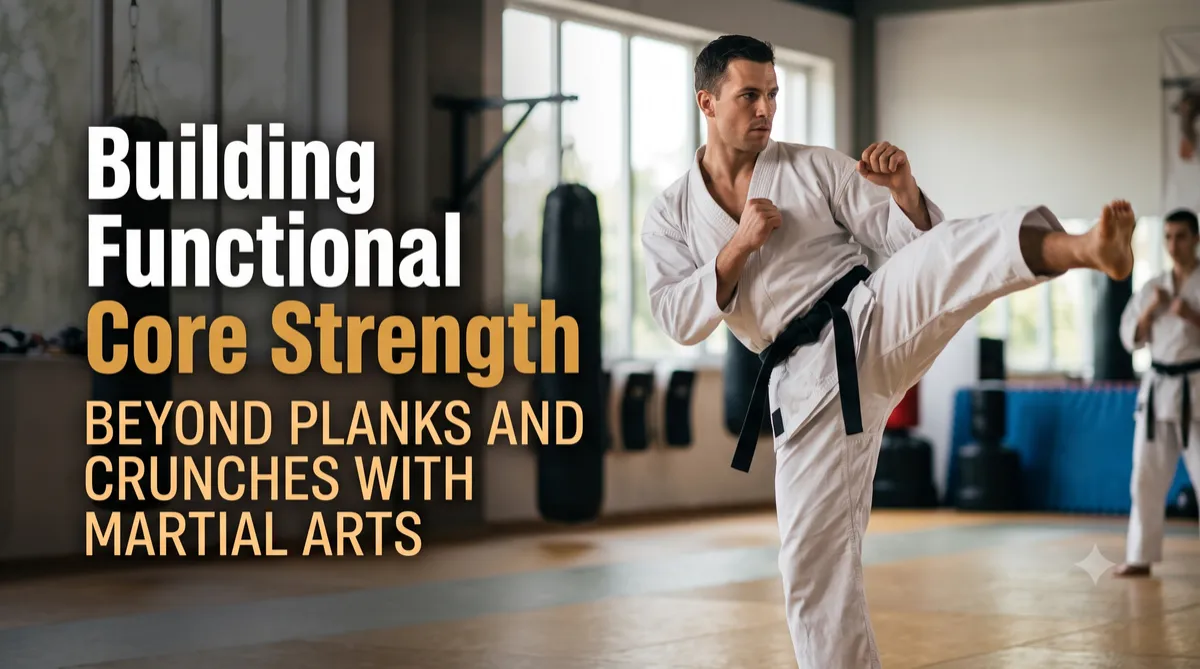
Kicking is one of the most noticeable ways martial arts challenges core muscles. When you lift one leg to perform a front kick or side kick, your body must remain stable on the supporting leg.
Your abdominal muscles, lower back, hips, and other stabilizing muscles work together to help prevent unnecessary movement.
As practitioners progress, they may learn to perform controlled kicks at different heights and angles. These movements challenge balance and coordination while encouraging better control of the torso.
Beginners should focus on technique, stability, and comfortable kicking height rather than trying to kick as high as possible.
Martial Arts Stances Strengthen Postural Control
Many martial arts styles use specific stances to develop balance, positioning, and control. These stances require practitioners to maintain an appropriate posture while distributing their weight between their legs.
Holding and transitioning between stances can challenge the muscles responsible for stabilizing the pelvis and torso.
Moving from one stance to another adds another layer of difficulty because the body must remain controlled while the feet and hips change position.
Over time, consistent practice can help improve postural awareness and movement coordination.
Defensive Techniques Train the Body to Resist Movement
Core strength is not just about creating movement. It also involves preventing unwanted movement.
During martial arts practice, students may learn to maintain their posture while stepping away from an incoming technique, changing direction, or practicing controlled partner drills.
These activities can challenge the body's ability to resist excessive rotation, bending, or loss of balance.
This type of control is useful in everyday activities that require carrying objects, reaching in different directions, or maintaining stability while moving.
Partner exercises should always be supervised and performed at an appropriate level of intensity.
Martial Arts vs. Planks and Crunches
Planks and crunches are not ineffective exercises. They can help strengthen the abdominal muscles when performed correctly. The difference is that martial arts develops core control through a broader range of coordinated movements.
Planks primarily challenge your ability to maintain a stable body position. Crunches emphasize controlled spinal flexion and abdominal muscle activity.
Martial arts incorporates rotation, balance, weight transfer, changes in direction, and coordination between the upper and lower body. Depending on the style and training session, it can also provide cardiovascular exercise.
This does not mean martial arts replaces every traditional core exercise. Instead, combining martial arts with targeted strength training can create a more comprehensive fitness routine.
The most suitable approach depends on your goals, experience, and physical abilities.
Martial Arts Movements That Challenge the Core
Different martial arts techniques place different demands on the body. Some useful examples include:
Front kicks: Challenge balance and require control of the torso while one leg is raised.
Roundhouse kicks: Involve hip rotation, weight transfer, and coordinated movement through the trunk.
Controlled punches: Encourage coordination between the feet, hips, torso, and arms.
Horse stance: Challenges the muscles responsible for maintaining posture and stabilizing the body.
Footwork drills: Require the practitioner to control their center of mass while stepping, pivoting, and changing direction.
Forms and patterns: Combine multiple techniques into a sequence, requiring practitioners to coordinate movement, breathing, posture, and balance.
The exact benefits depend on the martial arts style, the techniques practiced, and how consistently the student trains.
Benefits Beyond a Stronger Core
Improved Balance and Coordination
Martial arts frequently requires practitioners to move while maintaining control of their bodies. Kicks, pivots, defensive steps, and stance transitions can help develop balance and coordination.
These skills are relevant to sports and many everyday activities.
Better Movement Awareness
Learning martial arts techniques encourages students to notice their posture, foot placement, hip position, and movement patterns.
This awareness can help them identify when they are leaning too far, losing balance, or using unnecessary tension.
A More Engaging Fitness Routine
Some people find repetitive abdominal exercises difficult to maintain over time. Martial arts offers variety through techniques, combinations, forms, and structured classes.
Enjoyable physical activity may make it easier to maintain a consistent exercise habit.
Full-Body Conditioning
Martial arts training typically involves more than the abdominal muscles. Depending on the class, students may work their legs, shoulders, back, arms, and cardiovascular system.
This makes martial arts a useful option for people who want a varied workout rather than a routine focused on one muscle group.
Confidence and Discipline
Martial arts classes often emphasize patience, practice, self-control, and gradual skill development. Students work toward achievable goals and learn to improve through repetition.
For children, this structured environment can support confidence and perseverance. Adults may appreciate the combination of physical activity, mental focus, and measurable progress.
These benefits vary between individuals and depend partly on the quality of instruction and the training environment.
Can Beginners Build Core Strength Through Martial Arts?
Yes, Beginners can develop core control through appropriately modified martial arts training, even without prior experience or advanced fitness.
A beginner class may include basic stances, controlled punches, low kicks, footwork, warm-ups, and simple movement combinations. These activities introduce the body to new movement patterns without requiring advanced techniques.
New students should prioritize proper technique over speed, power, or flexibility. Attempting difficult kicks or rapid combinations before developing basic control can increase the risk of injury.
A qualified instructor can adapt movements to suit different ages, fitness levels, and physical abilities.
People with existing injuries, persistent back pain, or other physical limitations should seek appropriate professional guidance before beginning a demanding exercise program.
A Simple Martial Arts-Inspired Core Workout
You can introduce functional movement into your fitness routine with a short, beginner-friendly session. Warm up first, work within your comfortable range of motion, and rest whenever needed.
Warm-up: Spend a few minutes walking, marching in place, and performing gentle shoulder, hip, and ankle movements.
Horse stance: Hold a comfortable stance for 15–20 seconds while keeping your torso upright and breathing normally.
Controlled front kicks: Perform 6–8 low kicks per leg, returning each foot to the floor with control.
Slow punches with hip rotation: Practice 8–10 controlled punches per side, focusing on coordinated movement rather than power.
Forward and backward footwork: Move carefully between comfortable positions for 30 seconds while maintaining balance.
Standing knee raises: Raise one knee at a time without leaning backward. Perform 8–10 repetitions per side.
Repeat the sequence once more if it feels comfortable, then finish with gentle movement and recovery.
This routine is a general fitness example, not a substitute for martial arts instruction. It can complement regular training, but it does not replace a complete strength program.
How Often Should You Practice Martial Arts for Core Strength?
Consistency matters more than trying to do too much in a single session.
Beginners may start with two martial arts classes per week and gradually increase training frequency as their fitness and recovery improve. Some people may benefit from adding one or two short strength sessions that include exercises such as planks, bird dogs, dead bugs, and squats.
Allow adequate recovery between demanding workouts, particularly when you are new to exercise.
Progress can be measured through better balance, more controlled kicks, improved posture during techniques, and the ability to complete combinations without losing stability.
Visible abdominal definition is a separate goal influenced by factors such as overall body fat, nutrition, genetics, and training habits. Martial arts can contribute to general fitness, but it cannot guarantee a particular appearance.
Choosing the Right Martial Arts Class
If your goal is to improve functional core strength, look for a class that teaches sound technique and includes a balance of movement drills, stances, kicking, punching, and conditioning.
Taekwondo often includes kicking techniques and balance challenges. Karate may combine stances, punches, kicks, and structured forms. Kung fu encompasses many styles, some of which emphasize coordinated movement, footwork, and body control. Other martial arts can provide different physical challenges depending on their training methods.
Ask whether the instructor offers beginner-friendly modifications and how students progress toward more demanding techniques.
For children, consider class structure, instructor experience, age-appropriate activities, and safety practices. For adults, look for a training environment that supports individual progress without pressuring beginners to perform advanced movements too soon.
The best class is one that matches your goals and encourages you to train consistently and safely.
Conclusion
Building functional core strength involves more than performing endless planks and crunches. It requires the ability to stabilize your body, coordinate movements, maintain balance, and transfer force efficiently.
Martial arts provides opportunities to practice these skills through controlled kicks, rotational punches, defensive movements, stances, and footwork. It also offers a varied approach to fitness that can support coordination, discipline, and long-term exercise consistency.
Whether you are exploring martial arts for yourself or your child, start with basic techniques, choose a qualified instructor, and progress at a comfortable pace. By combining martial arts with appropriate strength training and recovery, you can work toward a stronger, more controlled, and more capable body.
Frequently Asked Questions
Can martial arts strengthen your core without doing crunches?
Yes. Martial arts movements such as kicks, punches, stance transitions, and footwork challenge the muscles that stabilize your torso. However, the amount of core development depends on the training style, intensity, and consistency.
Which martial art is best for core strength?
There is no single best option for everyone. Taekwondo, karate, and many kung fu styles include movements that challenge balance, coordination, and torso control. Choose a style based on your interests, abilities, and access to qualified instruction.
Is martial arts better than planks for core strength?
Neither is universally better. Planks provide a direct way to train core endurance, while martial arts challenges core control during dynamic movements. Combining both can be beneficial.
Can children improve core strength through martial arts?
Yes, Age-appropriate martial arts activities can help children practice balance, coordination, posture, and body control. Classes should emphasize safe movement, suitable technique, and individual development rather than intense conditioning.
How long does it take to notice improvements?
Some beginners may notice improvements in coordination and movement control within several weeks of consistent practice. Strength gains vary depending on training frequency, effort, recovery, and starting fitness level.